Been reading a beautifully written article by Vietnamese-American writer Andrew Lam (thanks Karlo Mila for bringing it to my attention!) I think a lot of what he says about Asian parents pushing their children towards a more professionally "secure" future is true - to an extent. Last week kiwi novellist and poet Alison Wong, in her acceptance speech for the NZ Post Book Award for Fiction, said that she initially disappointed her parents by becoming a writer (although no doubt they are very proud now). As I've found with my parents, they worry, not because they are ashamed of having an artist in the family (I'm definitely not the first), but because they come from a background of having lost everything and knowing the value of a professional degree.
The reason I quibble is that I think we are moving out of that generation now. I mix with a lot of fresh, joyously vibrant 20-somethings (and feel old and somewhat like I'm hiding my true age sometimes). Many of them are doing arts as their first career choice and have supportive, proud parents.
My parents are supportive too - in a slightly confused way - they're still not too sure about the path I'm taking, but they see that it makes me happy. I'm also different to Andrew and Alison in that I did actually take the professional path first. And that wasn't due to goading from my parents (although people assume that all the time). I really wanted to be a paediatrician, I chased the dream and enjoyed it, and it was only after I knew I'd get there that I realised I needed something else too.
So... are Asian artists more tortured than Western artists on this? I don't really think so, particularly not today. We're still underepresented in the NZ arts community, but rapidly growing as a group, and in a diverse range of fields. Yay!
Friday, September 10, 2010


Tuesday, August 17, 2010
Tuesday Poem: Big
This is the Big country
crammed into a small island
Big trucks on Big roads
drawing tight bands
across the belly of the land,
land that shudders
at the memory
of natives driven to destruction
trees this year
not people
not this election year.
Big heaters and Big power bills
to keep those home fires burning
Big people in Big houses
staring at the empty sea,
minds constricted
by all this space.
Tuesday crept up on me so apologies for posting a 'raw' poem which still needs a little baking. I've been working on the northern coast of Tasmania recently, and this poem explains a little of what I've been hearing and feeling - it's a lovely coastal spot, but marred by history and the fact that the big multinationals still have so much power here. They're pulping the native forests and mining in the National Park and the majority of the local population seem more interested in talking about their new cars and houses. I suppose NZ's not much better...
crammed into a small island
Big trucks on Big roads
drawing tight bands
across the belly of the land,
land that shudders
at the memory
of natives driven to destruction
trees this year
not people
not this election year.
Big heaters and Big power bills
to keep those home fires burning
Big people in Big houses
staring at the empty sea,
minds constricted
by all this space.
Tuesday crept up on me so apologies for posting a 'raw' poem which still needs a little baking. I've been working on the northern coast of Tasmania recently, and this poem explains a little of what I've been hearing and feeling - it's a lovely coastal spot, but marred by history and the fact that the big multinationals still have so much power here. They're pulping the native forests and mining in the National Park and the majority of the local population seem more interested in talking about their new cars and houses. I suppose NZ's not much better...
Monday, August 9, 2010
Tuesday poem: Body

I've just joined a new online poetry group, Tuesday poem . It's a wonderful way to get a fresh injection of poetic energy going into midweek (though I can't remember the last time I worked a "normal" 40-hour week). And for those of us with lazy poetic bones, it's a great stimulus for a stretch!
So: here's my inaugural 'Tuesday poem': actually a set of six sonnets, written as part of a larger project studying the archaeology of the person.
Brain
you swim
between islands
dive for words
sunken treasure
read the pulsation
of jellyfish
forget you can’t
breathe underwater
what you call memories
others call dreams
sometimes
you reach out
too far
and wake.
Lung
she once learnt
to tell the direction
of the wind
by wetting her finger
holding it up
to the sky
trying to understand
what cold was
now she’s been
to Antarctica
but still
she finds
most navigation
difficult.
Heart
she learnt
the valves
are tethered
like parachutes
that heart attacks
called infarctions
sound like
rude noises
that blood must balance
on both sides
and that
a healthy heart
tilts face upwards
like a question.
Liver
inside the liver
there are many suns
an inland river
ships and towns
factories and abattoirs
smelters and
storage towers
for sugar
a small girl standing
at a frosted window
her finger
drawing
a smiley face
on glass.
Spleen
that first day
she stood alone
in the playground
wet the wood chips
the following week
some big boys
pushed her
she lost her first tooth
after that she learnt
to keep her mouth shut
swallowed
her words whole
later spat them out
in silence.
Kidney
the principle of
countercurrent
exchange is like
two lovers kissing
talking
in tongues
limbs looped
in anticipation
the old Toyota
a warm uterus
to grow
new fruit
new dreams
new life.
Visit Tuesday Poem for more poetic lusciousness...
Saturday, July 3, 2010
The Sir Peter Blake Emerging Leader Awards

With the other Emerging Leaders and the Blake Medallist, Ray Avery.

With my personal spy, Mark
A couple of months ago I received a phone call at work from one Sir Ron Carter, one of NZ's iconic leaders. The news he had for me was (he said)very exciting but also top secret - so secret that even the hotel room was booked for me under a different name. But now the secret is out and I can reveal that I am a Sir Peter Blake Emerging Leader for 2010.
This is an important milestone, not only because I get a nice heavy trophy (for a rock it's very pretty) but because it's made me realise that I am being watched. Not in an uh-oh way, a nice way. Both my old school and my old university nominated me for this award. And though I'm still not sure what made them pick me over thousands of other achievers (was it the unusual arts-medicine work? the community involvement? the interesting path I took?), I am very, very grateful that people were looking out for me.
The wait gave me time to adjust my thinking. I was feeling weirded out for a while, and worried that the exposure from the award would affect the way I work. But now I've decided to think of it as a tap on the back. "You've been noticed, now step up and do some work."
There are a number of cool things I'm discovering. First, the award gives me a label. I'm now an "Emerging Leader", as identified by a nationally respected Panel. Though some aspects of that elitism sit about as uncomfortably as the corset I wore under my formal dinner gown, it does mean that people have some way to relate to me. This was illustrated by a "Women in Leadership" cocktail party I attended on Wednesday, in which I felt completely foreign. Nearly every other woman in the room was a CEO or high powered politician. They seemed puzzled that I was there, even though I'd taken off my scarf and had the foresight to put on makeup. But I was tailed around the room by the St Cuths staff (who were acting like proud mother hens) and when they introduced me to these powerful women as a Sir Peter Blake Emerging Leader, the fog cleared and everyone started talking to me. Bingo! The award is like being given the keys to a different part of the house, one I never really thought of exploring before. But it only opens the doors. I still have to walk through.
The second cool thing is that I get to talk. And I do like to talk. Apparently I'll start getting asked to go to schools and organisations to talk about leadership. I'm not exactly an expert(I've never really studied it). But the 'label' will give me the kind of believability that is also a huge responsibility. Yikes. As I said, I do like to talk, especially to kids, and watch them watch me openmouthed that a woman who moves her face so much when she talks could also be a leader... um, right, I'll stop talking now.

Posh Awards dinner - "after" photo
Thursday, June 10, 2010
Pecha Kucha presentation 2010 - The writer's toolbox
Following are the images and words from my presentation at the NZ Book Council Pecha Kucha night in Feb. (It's taken me ages to get around to typing them out). It was the second one I’d attended, the first I’d presented at. I wasn’t prepared for what I found at Galatos –a long queue of punters at the door (some were ended up being turned away), and inside the place already packed to capacity with chairs, floor space, walls and stairs all being used as places to sit or lean and people squashed elbow to elbow. Luckily Suzanne of the Book Council spotted me and pushed/pulled/dragged me through the crush to the reserved sanctuary near the front, and I felt rather small when I saw who else I was speaking alongside. It was like taking a huge hit from a wall of energy when I stood up to speak – I’ve hardly ever seen a NZ audience so engaged. Hurray for rock star moments!
NB: What I've posted below are my notes. In reality it went so fast I had no time to look down, so here's what I actually said....
Intro
I have a split personality. Sometimes I’m a poet, sometimes a short story writer, sometimes a performer, occasionally a novelist. Sometimes I’m a paediatrician and sometimes a researcher. You might think it’s difficult doing all these things but actually they support and enhance each other. I think of each skill as an item in a toolbox – so for each story or situation, I pick the best tool (or two.). Today I’d like to share a few waypoints on my personal journey, and show you some of my favourite tools.
 1. My career as an artist is only three years old. Three years ago, I experienced an awakening – of sorts. Like many, it was triggered by a personal tragedy. After a period of numbness, I responded by trying to find the stories in my life that would hold me together.
 2. So this is my crazy family – like all families, they are beautiful, mysterious, demanding, frustrating and energising – often all at the same time. This picture was taken by me on the day my nephew took his first steps. It was also a day when my family came together to celebrate the impending marriage of my youngest sister. And for me as a writer, this is where my stories start – the family.
 3. And the female relationships in my family are often the most interesting. This is a recent photo of my aunty feeding my grandmother, who’s in her 90s. On my aunty’s lap is my grandmother’s great grandchild. In the background is my younger sister. So there are four generations of women in this photo. I’ve found that again and again I’m drawn to exploring interrelationships and the ties that bind – willingly or unwillingly. The bloodlines and what draws us together, as families, as humans.
 4. So the first tool I discovered was poetry – on the page. I started making small chapbooks. This one was a family affair – with drawings by my sister and nephew, and poems about my family.
 5. And I also found poetry – in performance. This is Tim Heath, one of my friends, in full performance mode at Poetry Live. He’s competing in one of the regular Poetry Slams. Poetry Live has been around in Auckland for thirty years and isn’t going away anytime soon! Currently it’s on at the Thirsty Dog in K’Rd on Tuesday nights starting at 8 pm – I’d encourage you to go along.
 6. So then I discovered theatre. Here’s Jin Wenxin as the Daughter in Mask, the first of my short plays to be professionally produced in the Manawatu Festival of New Arts in 2008. As the playwright, I was inspired by the storytelling traditions of traditional Chinese Opera, although my knowledge of this is still from the position of an outsider. It helped me understand how to explore intergenerational relationships through the language of vision and movement as well as words – a new tool for my writer’s box.
 7. This led to Lantern, my first full length play, produced in 2009. Unsurprisingly, it’s a family drama – based on a NZ-Chinese family. In the process of writing this play I was able to play with a multistranded, multicharacter approach to storytelling, over a longer period of time. I learnt ‘on the job’ how to construct narrative which benefited the novel I’d begun in 2007.
 8. I also learnt about collaboration, in this case with a director and actors – leaving the space for others to ‘complete the gesture’. Here, Andy Wong and Li-Ming Hu embody a young NZ couple. I learnt how rehearsal needs a collaborative approach, but with recognised roles.
 9. Collaboration also happens with the audience in theatre – in fact community involvement in storytelling is one thing that makes a story more powerful. This picture is of the Lantern Project, in which members of the public were encouraged to leave their own poems written on paper lanterns. Eventually over 400 small lanterns, with poems, covered the walls in The Basement theatre foyer. It was easy to get that many poems – stories need to be told.
 10. There’s also a lot of collaboration within the arts community. This picture is from Metonymy, an “artistic blind dating” service dreamed up with fellow poet Christian Jensen and artists Hannah May Thompson and Makyla Curtis. We matched 33 pairs of artists and poets in both our first and second years, resulting in two well attended exhibitions, several new books, and a number of enduring partnerships.
 11. Workshops and teaching have been another new skill set. Whenever I’ve been out at schools and the community to teach, I’ve found that the learning is two-way. Here some kids at the Glen Innes school holiday program at Youthtown do “visual poetry” in the form of chalking stories about themselves.
 12. And there’s also performance in collaboration. During the People in Your Neighbourhood (2009) project organised by the British Council NZ, I had a brief moment as a rock star while performing with ghuzheng player Yao Chen and the UK-based Urban Soul orchestra. Here’s a picture of me performing at WOMAD to a crowd of over 5,000. The track – spoken word, traditional Chinese instrumentals and Western orchestrals – features on a CD and album downloadable free from the British Council website.
 13. I find writing in collaboration very satisfying. Here I am with Robbie Ellis, Catherine Norton and Frances Moore, at the Bay of Islands Arts Festival a few weeks ago. Robbie set some of the poems from Banana, the chapbook I showed earlier, to music. Just to show we’re into mixing it up culturewise: the premiere of Seven Banana Songs took place in an 140 year old Anglican church, with a Chinese-kiwi poet and western composer and singer.
 14. In my most recent project, I’ve found all these ‘tools’ coming together. This picture from historical archives shows survivors from the SS Ventnor, which was wrecked off the coast of the Hokianga harbour in 1902. The ship carried an unusual cargo – 499 coffins of Chinese who had come to NZ to work but had died before they could be repatriated to their home villages.
 15. When I was exploring the strands of this story, I found myself back at the bloodlines – the ties that bind and connect us. This is an image used for promoting The Bonefeeder which is by Nagpuhi, Irish and Scottish artist Penny Howard – who traces her bloodlines back to the Hokianga. Penny and I met on Metonymy.
 16. The Bonefeeder is the story of a young man who travels to the Hokianga in search of his great great grandfather’s bones. The play was first produced at the end of last year at Auckland University, and this picture shows Mike Ginn in the title role with Ben Teh as his much older relative…
 17. …and the ghosts of dead miners haunting their every (mis)step. This project added another tool to my toolbox – direction. I was able to experiment with the traditions of Asian theatre and European forms such as Greek theatre, as well as physical theatre.
 18. Doing this, I found out how to write poetry without words. Theatre is poetry on stage as well as on the page – working with all the elements – lighting, costumes, actors’ bodies.
 19. I also collaborated with live musicians – a group called New Nature who I’d met through the People In Your Neighbourhood Project – and composer Andrew Correa. We’re currently excited about rehearsing for an outside ‘promenade’ version of the play, to be performed at the Hamilton Summer Gardens Arts Festival.
 20. And this is my last image – a new baby awakening the stories and memories of her great grandmother. It’s a reminder that all the tools of a writer are no use without a story that matters. These are (for me) all family stories at their heart - The Bone Feeder is a ghost story that turned after several rewrites into a family drama.
NB: What I've posted below are my notes. In reality it went so fast I had no time to look down, so here's what I actually said....
Intro
I have a split personality. Sometimes I’m a poet, sometimes a short story writer, sometimes a performer, occasionally a novelist. Sometimes I’m a paediatrician and sometimes a researcher. You might think it’s difficult doing all these things but actually they support and enhance each other. I think of each skill as an item in a toolbox – so for each story or situation, I pick the best tool (or two.). Today I’d like to share a few waypoints on my personal journey, and show you some of my favourite tools.
 1. My career as an artist is only three years old. Three years ago, I experienced an awakening – of sorts. Like many, it was triggered by a personal tragedy. After a period of numbness, I responded by trying to find the stories in my life that would hold me together.
 2. So this is my crazy family – like all families, they are beautiful, mysterious, demanding, frustrating and energising – often all at the same time. This picture was taken by me on the day my nephew took his first steps. It was also a day when my family came together to celebrate the impending marriage of my youngest sister. And for me as a writer, this is where my stories start – the family.
 3. And the female relationships in my family are often the most interesting. This is a recent photo of my aunty feeding my grandmother, who’s in her 90s. On my aunty’s lap is my grandmother’s great grandchild. In the background is my younger sister. So there are four generations of women in this photo. I’ve found that again and again I’m drawn to exploring interrelationships and the ties that bind – willingly or unwillingly. The bloodlines and what draws us together, as families, as humans.
 4. So the first tool I discovered was poetry – on the page. I started making small chapbooks. This one was a family affair – with drawings by my sister and nephew, and poems about my family.
 5. And I also found poetry – in performance. This is Tim Heath, one of my friends, in full performance mode at Poetry Live. He’s competing in one of the regular Poetry Slams. Poetry Live has been around in Auckland for thirty years and isn’t going away anytime soon! Currently it’s on at the Thirsty Dog in K’Rd on Tuesday nights starting at 8 pm – I’d encourage you to go along.
 6. So then I discovered theatre. Here’s Jin Wenxin as the Daughter in Mask, the first of my short plays to be professionally produced in the Manawatu Festival of New Arts in 2008. As the playwright, I was inspired by the storytelling traditions of traditional Chinese Opera, although my knowledge of this is still from the position of an outsider. It helped me understand how to explore intergenerational relationships through the language of vision and movement as well as words – a new tool for my writer’s box.
 7. This led to Lantern, my first full length play, produced in 2009. Unsurprisingly, it’s a family drama – based on a NZ-Chinese family. In the process of writing this play I was able to play with a multistranded, multicharacter approach to storytelling, over a longer period of time. I learnt ‘on the job’ how to construct narrative which benefited the novel I’d begun in 2007.
 8. I also learnt about collaboration, in this case with a director and actors – leaving the space for others to ‘complete the gesture’. Here, Andy Wong and Li-Ming Hu embody a young NZ couple. I learnt how rehearsal needs a collaborative approach, but with recognised roles.
 9. Collaboration also happens with the audience in theatre – in fact community involvement in storytelling is one thing that makes a story more powerful. This picture is of the Lantern Project, in which members of the public were encouraged to leave their own poems written on paper lanterns. Eventually over 400 small lanterns, with poems, covered the walls in The Basement theatre foyer. It was easy to get that many poems – stories need to be told.
 10. There’s also a lot of collaboration within the arts community. This picture is from Metonymy, an “artistic blind dating” service dreamed up with fellow poet Christian Jensen and artists Hannah May Thompson and Makyla Curtis. We matched 33 pairs of artists and poets in both our first and second years, resulting in two well attended exhibitions, several new books, and a number of enduring partnerships.
 11. Workshops and teaching have been another new skill set. Whenever I’ve been out at schools and the community to teach, I’ve found that the learning is two-way. Here some kids at the Glen Innes school holiday program at Youthtown do “visual poetry” in the form of chalking stories about themselves.
 12. And there’s also performance in collaboration. During the People in Your Neighbourhood (2009) project organised by the British Council NZ, I had a brief moment as a rock star while performing with ghuzheng player Yao Chen and the UK-based Urban Soul orchestra. Here’s a picture of me performing at WOMAD to a crowd of over 5,000. The track – spoken word, traditional Chinese instrumentals and Western orchestrals – features on a CD and album downloadable free from the British Council website.
 13. I find writing in collaboration very satisfying. Here I am with Robbie Ellis, Catherine Norton and Frances Moore, at the Bay of Islands Arts Festival a few weeks ago. Robbie set some of the poems from Banana, the chapbook I showed earlier, to music. Just to show we’re into mixing it up culturewise: the premiere of Seven Banana Songs took place in an 140 year old Anglican church, with a Chinese-kiwi poet and western composer and singer.
 14. In my most recent project, I’ve found all these ‘tools’ coming together. This picture from historical archives shows survivors from the SS Ventnor, which was wrecked off the coast of the Hokianga harbour in 1902. The ship carried an unusual cargo – 499 coffins of Chinese who had come to NZ to work but had died before they could be repatriated to their home villages.
 15. When I was exploring the strands of this story, I found myself back at the bloodlines – the ties that bind and connect us. This is an image used for promoting The Bonefeeder which is by Nagpuhi, Irish and Scottish artist Penny Howard – who traces her bloodlines back to the Hokianga. Penny and I met on Metonymy.
 16. The Bonefeeder is the story of a young man who travels to the Hokianga in search of his great great grandfather’s bones. The play was first produced at the end of last year at Auckland University, and this picture shows Mike Ginn in the title role with Ben Teh as his much older relative…
 17. …and the ghosts of dead miners haunting their every (mis)step. This project added another tool to my toolbox – direction. I was able to experiment with the traditions of Asian theatre and European forms such as Greek theatre, as well as physical theatre.
 18. Doing this, I found out how to write poetry without words. Theatre is poetry on stage as well as on the page – working with all the elements – lighting, costumes, actors’ bodies.
 19. I also collaborated with live musicians – a group called New Nature who I’d met through the People In Your Neighbourhood Project – and composer Andrew Correa. We’re currently excited about rehearsing for an outside ‘promenade’ version of the play, to be performed at the Hamilton Summer Gardens Arts Festival.
 20. And this is my last image – a new baby awakening the stories and memories of her great grandmother. It’s a reminder that all the tools of a writer are no use without a story that matters. These are (for me) all family stories at their heart - The Bone Feeder is a ghost story that turned after several rewrites into a family drama.
Monday, June 7, 2010
Metonymy 2010
It's official and we've started getting the word out: Metonymy 2010 collabrations happen next month, with exhibtions and performances September to October. For those who don't know, this is a creative collaboration aimed at creating new links between artistic disciplines - everyone who's serious about making good writing or art is welcome! http://metonymy.weebly.com/
Sunday, April 4, 2010
Emerging Pacific Leaders' Dialogue, March 2010
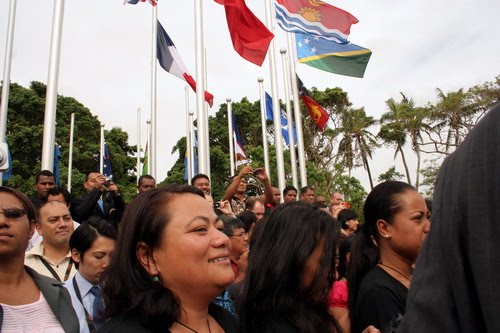
There were 130 of us, from 22 Pacific nations.

Princess Anne came to the closing plenary in Tonga, to watch and comment on our presentations.

The Fiji Study group presentation - a series of devised monologues with choreographed "dance" (I directed).

Baby Boa! (I liked - but not so everyone in my group).

Sweet arch...in a tunnel of sugar cane

Our welcome kava ceremony in Fiji.

The amazing, cool and totally wonderful Fiji Study group!!
Monday, March 29, 2010
Subscribe to:
Posts (Atom)